Featured Offer: AI Accelerators
Industry-optimized AI tools designed to solve your toughest challenges in weeks, not months.
Capabilities
Discover Our Benefits & Values



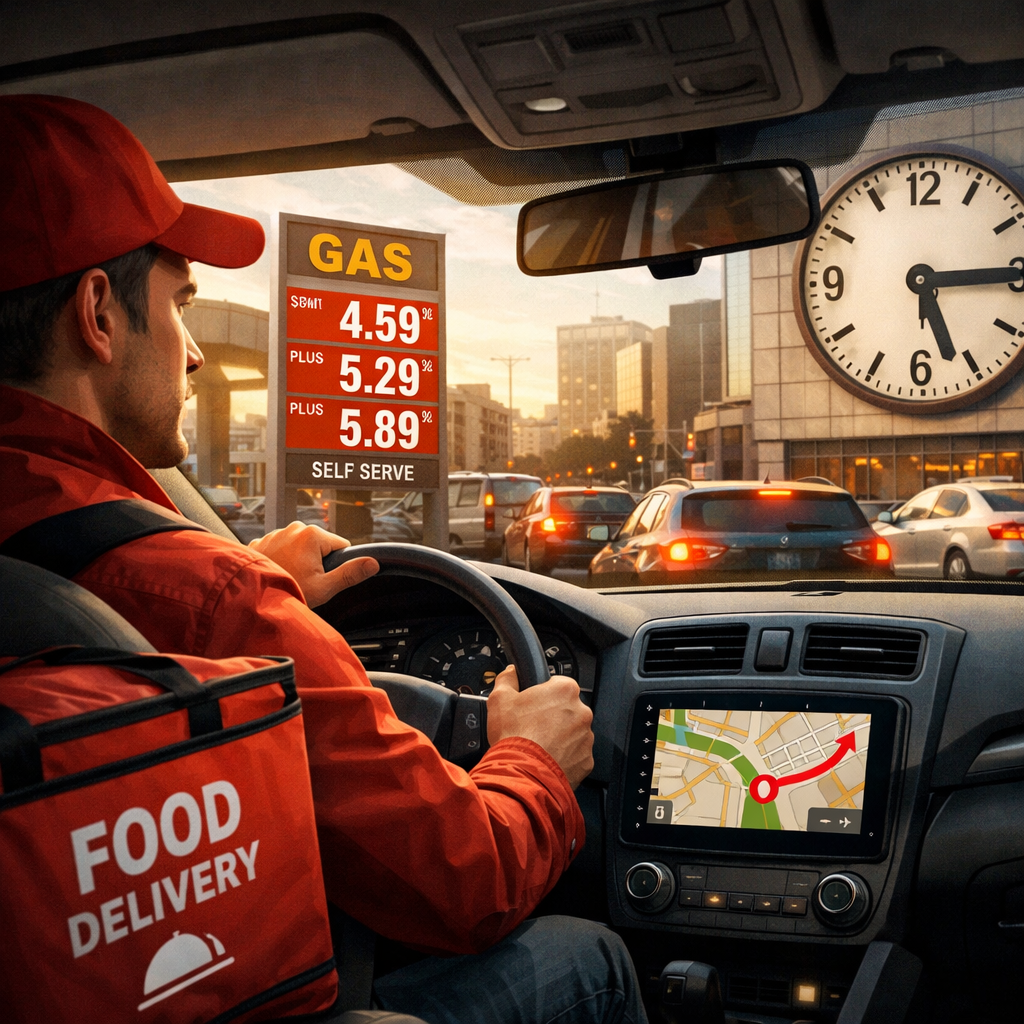

The convenience of having a hot meal delivered to your doorstep is something many people take for granted. A few taps, and twenty minutes later, dinner arrives.
What is less visible is the operating model behind that experience, and right now that model is under pressure.
From our perspective, this is not a temporary disruption. It is a structural weakness becoming visible.
We are seeing this play out in real time. Rising fuel costs are not just a line item. They are actively reshaping how delivery networks function, from driver behavior to platform economics.
A recent NPR report highlighted what many operators are already feeling. The math for delivery is changing quickly, and not in a stable direction.
For drivers working with platforms like Uber Eats, Grubhub, and DoorDash, margins have always been tight. Fuel, maintenance, and insurance sit entirely with the driver.
When gas prices rise, the model compresses immediately.
What stood out in the NPR reporting is how precise drivers have become. Many track performance down to the mile, not the hour. That shift alone reflects how fragile the economics are.
This is often framed as a labor issue. It is not. It is a systems design problem. And those types of issues tend to surface under cost pressure before they are addressed structurally.
Platforms and brands are not ignoring this pressure, but the responses vary.
DoorDash, for example, introduced temporary fuel incentives such as cash back on gas and bonuses for high-mileage drivers. These are necessary in the moment, but they do not address the underlying structure.
Then there is Domino’s.
Domino’s historically controlled its delivery network end-to-end. That model provided consistency, but it also carried fixed costs. As labor tightened and delivery became more expensive, even Domino’s had to adapt. They encouraged pickup and, more notably, partnered with Uber Eats. Moves like this are less about experimentation and more about adapting to structural cost pressure.
We view that shift as a signal. It shows that no single model, gig or in-house, is insulated from cost pressure. Most are moving toward some form of hybrid, whether by design or necessity.
At the driver level, behavior is already adjusting.
Drivers are becoming more selective. They reject the majority of orders, stay within tight geographic zones, and prioritize trips that minimize idle miles.
Some are shifting to different types of work entirely, such as grocery delivery, where the economics are marginally better.
From an operations standpoint, this is predictable. When cost volatility increases, the network fragments. Efficiency becomes localized. Coverage becomes inconsistent. Over time, that inconsistency becomes visible at the brand level.
This does not stay contained at the driver level.
Customers are starting to feel it. Orders sit longer. Low-tip orders go unaccepted. Service variability increases.
We are moving toward a model where a tip is not just a reward. It is part of the pricing mechanism that determines whether the service happens at all.
That is a meaningful shift. It changes how we should think about pricing, service levels, and customer expectations.
Stepping back, this is not just about gas prices.
It is about whether the current delivery model can absorb external shocks without breaking down.
Right now, much of the system depends on variables that are outside of the platform’s control, including fuel prices, labor behavior, and customer tipping patterns.
That creates instability. In our experience, models with this level of dependency tend to require redesign rather than incremental adjustment.
Short-term incentives help. They do not solve the underlying issue.
The question is whether the operating model evolves fast enough to support that demand in a sustainable way.
This is unlikely to be a temporary adjustment. It points to a broader redesign in how delivery networks are structured.
From our perspective, the next phase will require more deliberate design:
The companies that figure this out will not just maintain delivery. They will stabilize it.
Because ultimately, convenience only works when the system behind it does.
See how we can help: Schedule a meeting today.



Technology & Process for Growth
601 Valencia Ave, Suite 260
Brea, CA 92823
Call us: 1-866-749-7658
No Comments Yet
Let us know what you think