Featured Offer: AI Accelerators
Industry-optimized AI tools designed to solve your toughest challenges in weeks, not months.
Capabilities
Discover Our Benefits & Values



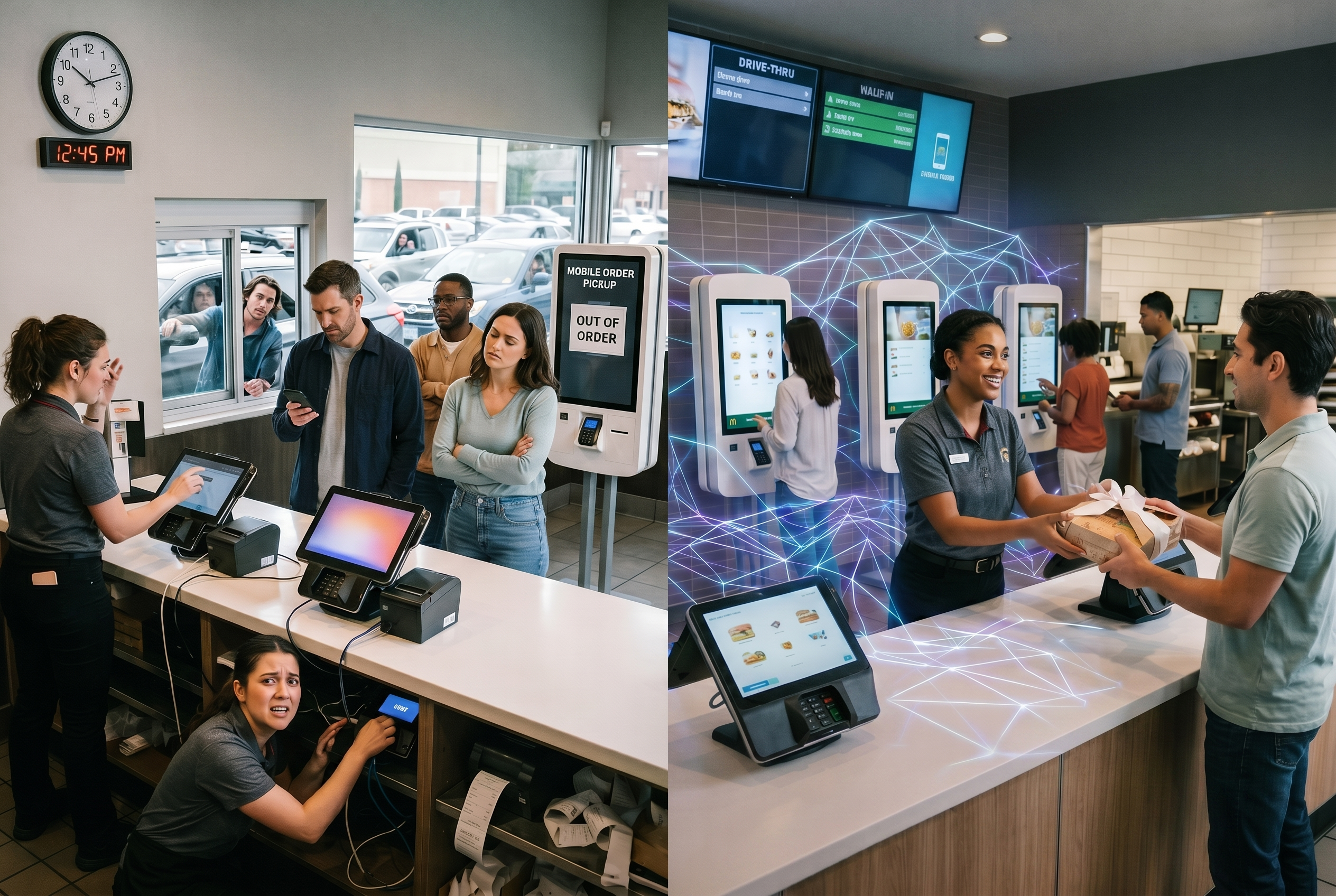

Most customers do not think about restaurant technology until something stops working.
The drive-thru line suddenly stalls. Mobile orders stop flowing correctly. An employee disappears into the back trying to troubleshoot a printer issue during lunch rush. Nobody in the restaurant announces there is a systems problem, but customers feel it almost immediately.
That is why some of the most important AI conversations happening in Quick Service Restaurants right now have less to do with automation and more to do with operational continuity.
A lot of the industry discussion around AI still centers on labor savings, speed, and efficiency. Those things matter. But from what we are seeing across restaurant operations, the bigger opportunity is reducing friction before it reaches the customer experience.
Because in QSR environments, operational friction eventually becomes customer friction.
A disconnected POS terminal. A delayed kitchen system. A network issue impacting mobile ordering. Most customers never know the technical root cause. They only know the line stopped moving, the order took too long, or the experience felt frustrating.
That is where AI is starting to create real value.
The strongest AI implementations in restaurants are not replacing hospitality. They are helping protect it.
When operational support becomes faster, more proactive, and more accessible in real time, restaurants can recover from issues faster, reduce service interruptions, improve order accuracy, and create more consistent experiences across every ordering channel.
Increasingly, AI is becoming just as much a customer experience technology as an operational one.
The Real Challenge Is Not Technology
Most major restaurant brands already have sophisticated systems in place.
The challenge is not whether the technology exists. It is whether frontline teams can keep operations moving smoothly when pressure hits the store environment.
And this is where restaurants often struggle.
Operational issues rarely fail dramatically. More often, they stall. A kitchen display slows down. A payment system disconnects intermittently. Mobile orders stop syncing correctly. Employees lose valuable minutes troubleshooting instead of serving customers.
Those delays compound quickly during peak periods.
Customers may never know why the disruption happened. But they absolutely feel the effect of it.
From an operational standpoint, that is why continuity matters so much. The brands creating the best customer experiences are often the ones resolving issues before customers fully experience the disruption.
Faster Support Creates Better Experiences
One of the most practical ways AI is improving restaurant operations today is by reducing the time between a problem occurring and the problem being resolved.
In many restaurants, troubleshooting still depends heavily on escalation chains, documentation searches, or waiting for callbacks while the store continues operating under pressure.
AI-assisted support changes that dynamic.
Conversational support systems can guide employees through troubleshooting in real time, surface likely fixes immediately, and help resolve common operational issues without lengthy delays. Instead of employees stopping service to search for answers, support becomes embedded directly into the workflow.
For customers, the benefit is simple:
Customers rarely care why a technical issue occurred. They care whether the restaurant continues operating smoothly while it is happening.
That continuity matters more than most brands realize.
The Best AI Strategies Remove Friction, Not People
There is still a misconception that AI in restaurants is primarily about replacing labor.
In reality, the strongest implementations are helping employees spend less time fighting systems and more time focused on hospitality.
Wendy’s, for example, has publicly discussed how its FreshAI drive-thru platform is improving order accuracy and creating more natural ordering experiences. White Castle has similarly positioned AI voice ordering as a way to reduce stressful customer interactions while improving flow during busy periods.
The common thread is not replacement. It is friction reduction.
That distinction matters.
When repetitive troubleshooting, routine escalations, and operational interruptions are handled faster, employees can focus more attention on:
The restaurants that implement AI successfully will likely be the ones that balance automation with stronger human experiences, not weaker ones.
Consistency Is Becoming the Competitive Advantage
For large multi-location restaurant brands, consistency is one of the hardest things to maintain.
Customers expect the same experience whether they visit a location in Dallas, Los Angeles, New York, or Manila. But operational inconsistency shows up quickly when systems, staffing, and support processes vary from store to store.
This is another area where AI can create meaningful value.
AI-assisted operational support can help standardize troubleshooting, guidance, and issue resolution across locations, reducing the variability that often occurs during busy shifts or operational disruptions.
The result is not just efficiency. It is predictability.
And in QSR, predictability builds trust.
Customers may not consciously remember a perfectly functioning restaurant experience, but they immediately remember friction, delays, and inconsistency.
The brands that reduce those moments most effectively will likely have a long-term advantage.
The Future of QSR Experience
The future of AI in restaurants is not about removing human interaction.
It is about creating environments where customers experience fewer disruptions, employees have better support, and restaurant operations recover faster when issues occur.
From what we are seeing across the industry, this is unlikely to be a temporary shift. Restaurants are moving toward environments in which operational support becomes more intelligent, more proactive, and more directly integrated into frontline workflows.
Customers may never see the technology working behind the scenes.
But they will absolutely feel the difference.
And in QSR, where loyalty is often shaped by speed, convenience, and consistency, reducing operational friction may become one of the most important competitive advantages of all.




Technology & Process for Growth
601 Valencia Ave, Suite 260
Brea, CA 92823
Call us: 1-866-749-7658
No Comments Yet
Let us know what you think